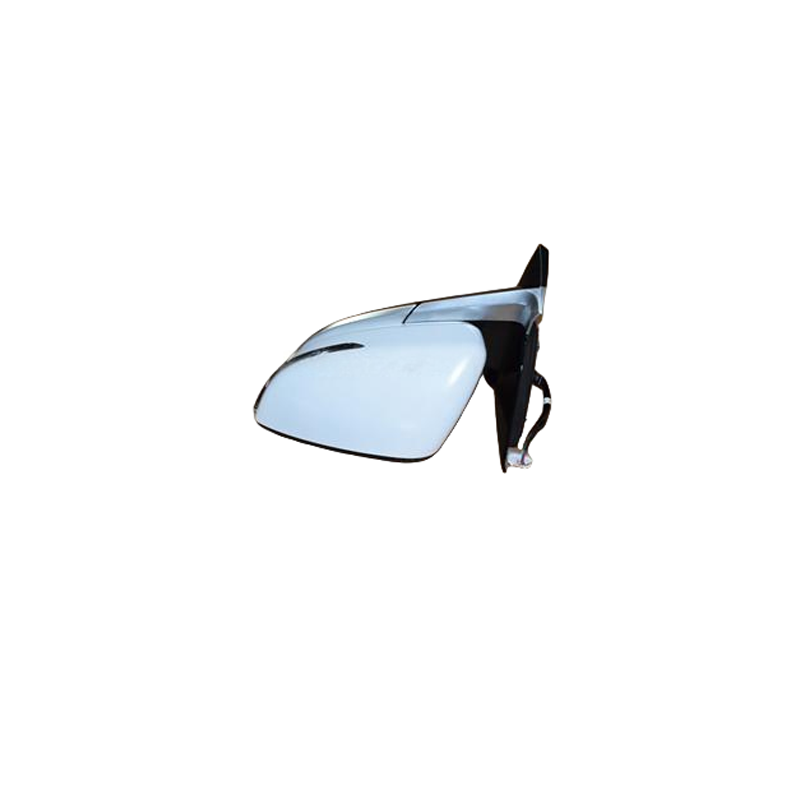
Repairing method for loose rearview mirror of a car
The loose rearview mirror of a car can be fixed by tightening the screws, adjusting the ball joint, reinforcing with structural glue, or replacing the parts. The specific method to be chosen depends on the location of the looseness.
Repair methods for different parts
Screw loosening: Locate the screws on the base of the rearview mirror or the inner side of the car door, and for some models, you may need to pry open the decorative cover and use a screwdriver to tighten them clockwise. The recommended torque is 8-10 N·m.
Ball joint/rotor loosening: Locate the adjusting hole below the rearview mirror and insert a special tool to fine-tune the loosening screws. If the ball joint wears out and the gap exceeds 2mm, replace the original factory ball joint part.
Loose adhesive area: If the inner rearview mirror detaches from the windshield, clean the contact surface with alcohol, apply high-temperature automotive-specific structural glue (such as 3M DP420), and press it firmly.
Operating precautions
Thread direction: Some German models have reverse thread design. Confirm the rotation direction before operating to avoid slippage.
Circuit safety: When dealing with electronic anti-glare rearview mirrors, disconnect the power supply before operating to prevent circuit damage.
Curing time: After reinforcing with structural glue, the inner rearview mirror needs to cure for 2 hours in summer and 4 hours in winter. Avoid shaking the rearview mirror within 24 hours.
Suggestions for severe damage handling
Part replacement: If the mirror lens is loose, you can purchase a compatible lens for replacement; if the base is deformed or involves complex circuit disassembly, it is recommended to replace the rearview mirror assembly.
The rearview mirror of a car is a convex mirror, not a convex lens or concave lens. It can expand the field of vision and reduce blind spots, forming a upright and reduced virtual image, thereby improving driving safety. While the interior rearview mirror usually uses a plane mirror.
The optical characteristics of the convex mirror and the difference from lenses
The rearview mirror of a car is a convex mirror, not a lens: Convex lenses and concave lenses are light-transmitting components that form images through refraction; while the convex mirror is a reflective mirror that uses the outer side of the spherical surface to reflect light. The core function of the rearview mirror is to reflect the scene behind the vehicle, so it uses a convex mirror instead of a lens.
The imaging principle of the convex mirror: The convex mirror produces a upright and reduced virtual image, which makes the objects seen in the mirror appear smaller than they are in reality, but the field of vision is larger than the same-sized plane mirror. This characteristic stems from the diverging effect of the convex mirror on light, allowing the driver to observe a wider rear area during reversing, effectively reducing blind spots.
Types and functions of car rearview mirrors
External rearview mirror (reverse mirror): Usually installed on both sides of the vehicle, it adopts a convex mirror design to expand the field of vision and help the driver observe the rear and side situations, improving driving and reversing safety.
Internal rearview mirror: Usually installed in the front of the vehicle, it is used to observe the rear of the vehicle, and most use plane mirrors, providing a distortion-free true image for accurate distance judgment. However, some vehicles' internal rearview mirrors may also have anti-glare or automatic adjustment functions.
Auxiliary mirror: Such as a small round mirror (wide-angle mirror), it is also a convex mirror and can be attached to the rearview mirror to further expand the field of vision of a specific area, often used to observe the area near the tires or narrow areas.
The working principle of the rearview mirror (i.e., car rearview mirror) mainly relies on optical reflection and mirror curvature design, aiming to expand the field of vision, reduce blind spots, and enhance driving safety.
Core principle
Reflection principle: The rearview mirror reflects the light from behind and on the sides of the vehicle through the mirror surface, allowing the driver to see the road conditions behind and on the sides. This is the basic working principle of all rearview mirrors.
Convex mirror design: External rearview mirrors usually use convex mirrors (the outer side of the spherical surface as the reflecting surface), rather than plane mirrors or lenses. Concave mirrors can diverge incident light, forming a virtual image that is upright and reduced in size, thereby enabling a wider field of view within a limited mirror surface area.
The three elements of the field of vision:
The field of vision is determined by the following three factors:
The distance between the driver's eyes and the mirror surface;
The size of the mirror surface;
The radius of curvature of the mirror surface (the smaller the curvature, the wider the field of vision).
Characteristics of different types of rearview mirrors
External rearview mirrors (left and right):
Most are convex mirrors or hyperbolic mirrors (inner plane, outer convex surface), providing a wider field of vision but with distance distortion;
The right external rearview mirror, as the driver is on the left side, has a larger blind area, so a larger curvature is often used to cover near-distance obstacles.
Internal rearview mirrors (in the center of the vehicle interior):
Most are plane mirrors, providing a true and distortion-free image, facilitating judgment of the distance of vehicles behind;
High-end models are equipped with anti-glare internal rearview mirrors, which automatically reduce strong light interference through electrochromic technology.
Underview mirrors (used mostly in large vehicles):
Using convex reflective mirrors combined, the images of the vehicle bottom and the surrounding tires are refracted to the front of the driver's seat, assisting in observing the blind area below.
Function evolution
Modern reversing mirrors have integrated multiple intelligent functions:
Electric adjustment, heating and deicing, automatic anti-glare;
Integrated blind spot monitoring, 360° panoramic imaging;
Some models use electronic rearview mirrors (camera + display), gradually replacing traditional physical lenses.
Note: Some sources mistakenly claim that rearview mirrors use the "refraction principle", but mainstream authoritative sources (such as Baidu Encyclopedia, Pacific Auto) clearly state that the core is the "reflection principle", and convex mirrors achieve wide-angle imaging through reflection, and refraction is not the main mechanism.
If you want to know more, keep reading the other articles on this site!
Please call us if you need such products.
Zhuo Meng Shanghai Auto Co., Ltd. is committed to selling MG&MAXUS auto parts welcome to buy.