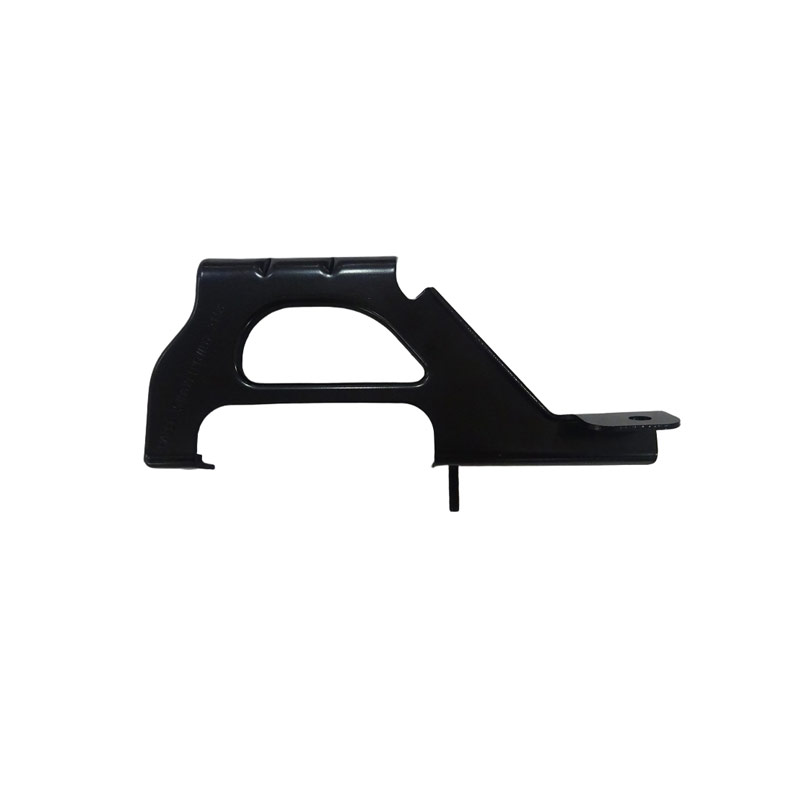
What is the assembly of the vehicle brake fluid reservoir mounting bracket?
The automotive brake fluid reservoir mounting bracket assembly is a key structural component in the automotive braking system, mainly used to fix and support the brake fluid reservoir (also known as the brake fluid storage tank) and its related components, ensuring that it remains stable, sealed and reliable during vehicle operation, and is correctly connected to the brake master cylinder, clutch master cylinder, and other components.
According to public information, this assembly typically has the following functions and features:
Structural composition: Generally includes the bracket body, installation clips or bolt fixation points, and sometimes integrates a liquid level alarm device, oil outlet interface, etc.
Installation location: Usually located in the engine compartment, directly connected to the brake master cylinder or fixed independently on the frame.
Function and effect: Ensure the stable installation of the brake fluid reservoir, prevent loosening or leakage due to vibration; provide an inlet and outlet channel for the brake fluid, connect the brake master cylinder and clutch master cylinder (for some models); support the liquid level sensor or alarm device to monitor the brake fluid level.
For example, in the design of a certain new energy vehicle brake pump assembly, this assembly clearly includes the pump body, filling tank and mounting bracket, used to compress the brake fluid and shorten the braking distance. Additionally, specific models such as "HA2EL-3540040" for the brake fluid reservoir mounting bracket assembly have appeared in enterprise standards, indicating that it is a standardized component.
The main function of the automotive brake fluid reservoir mounting bracket assembly is to fix the brake fluid reservoir (storage tank) and ensure its reliable connection and sealing with the brake master cylinder, clutch master cylinder, and other components, thereby ensuring the normal operation of the hydraulic braking system. The specific functions include:
Structural support and positioning: Securely install the brake fluid reservoir on the engine compartment or related brackets to prevent loosening, displacement or damage due to vehicle vibration.
Integrated liquid level sensing function: Some bracket assemblies integrate a liquid level sensor to monitor the height of the brake fluid level. When the level is too low, it sends an alarm signal to the vehicle ECU to enhance driving safety.
Optimized pipe layout: Through reasonable design of interface positions, reduce additional hose connections, simplify assembly processes, and reduce the risk of leakage.
Enhanced system reliability: Use corrosion-resistant and high-temperature-resistant materials to adapt to complex environments and ensure long-term use of sealing and structural integrity.
This assembly is usually a supporting component for the brake master cylinder, and the installation fixing bolt torque is generally 20 N·m. If the bracket is loose or damaged, it may cause brake fluid leakage, sensor false alarms (such as triggering ESP/ABS faults), and affect braking performance.
Common faults of the automotive brake fluid reservoir mounting bracket assembly usually involve issues related to brake fluid storage, sensor signals or mechanical fixation. Based on the latest public information, combined with the current time (April 2026), the following key information is summarized:
Common fault manifestations
Brake system, ESP or parking brake warning light on the dashboard
Most cases are caused by the failure of the liquid level sensor, even if the brake fluid is actually sufficient, the system still misreports a fault.
Abnormal brake pedal
If the stroke length increases or the pedal returns slowly after being depressed, it may be related to the brake master cylinder or pipe sealing of the bracket assembly that is damaged.
Brake fluid leakage
Poor sealing of the bracket assembly or cracking of the reservoir body will cause the liquid level to drop rapidly.
Continuous alarm or repeated fault codes during vehicle operation
Common in some models (such as Peugeot 3008, Citroën C5, etc.), often due to the failure of the liquid level sensor integrated in the reservoir body.
Typical fault causes
Liquid level sensor failure: Unable to accurately detect the liquid level, triggering false alarms .
Bracket body cracking or deformation: Long-term vibration or material aging leading to failure of fixation, possibly causing the reservoir to shift or the pipe to be pulled . Sealing parts aging or oil pipe joints loosening: causes slow leakage of brake fluid.
Internal circuits or plugs corrosion: especially in humid environments, sensor plugs are prone to oxidation, leading to abnormal signals.
Suggested handling steps:
Read the fault code: Use an OBD device to confirm if it is a fault related to the brake fluid level sensor (such as P1xxx series codes).
Visual inspection:
Check if the oil tank has cracks or deformations;
Inspect the bottom and oil pipe joints for oil stains;
Check if the sensor plug is loose or corroded.
Replace the assembly:
Most models cannot replace the sensor separately; they need to replace the entire brake fluid tank assembly (including the bracket). Some domestic models (such as 3008) can refer to the universal part number to reduce costs.
Professional exhaust and filling:
After replacement, it is necessary to discharge air from the braking system and use standard brake fluid (such as DOT4 or DOT5.1).
Note: The braking system is related to driving safety. If unsure about the operation, it is recommended to handle it at a professional repair shop. When disassembling by yourself, protection is required (brake fluid is corrosive), and tools such as a container for collecting the fluid, T-series hex socket wrench, and sockets should be prepared.
If you want to know more, keep reading the other articles on this site!
Please call us if you need such products.
Zhuo Meng Shanghai Auto Co., Ltd. is committed to selling MG&MAXUS auto parts welcome to buy.